Aug 18, 2026News & Insights
Can AI Smart Glasses Work Without WiFi? Understanding the Limits of Bluetooth Transmission
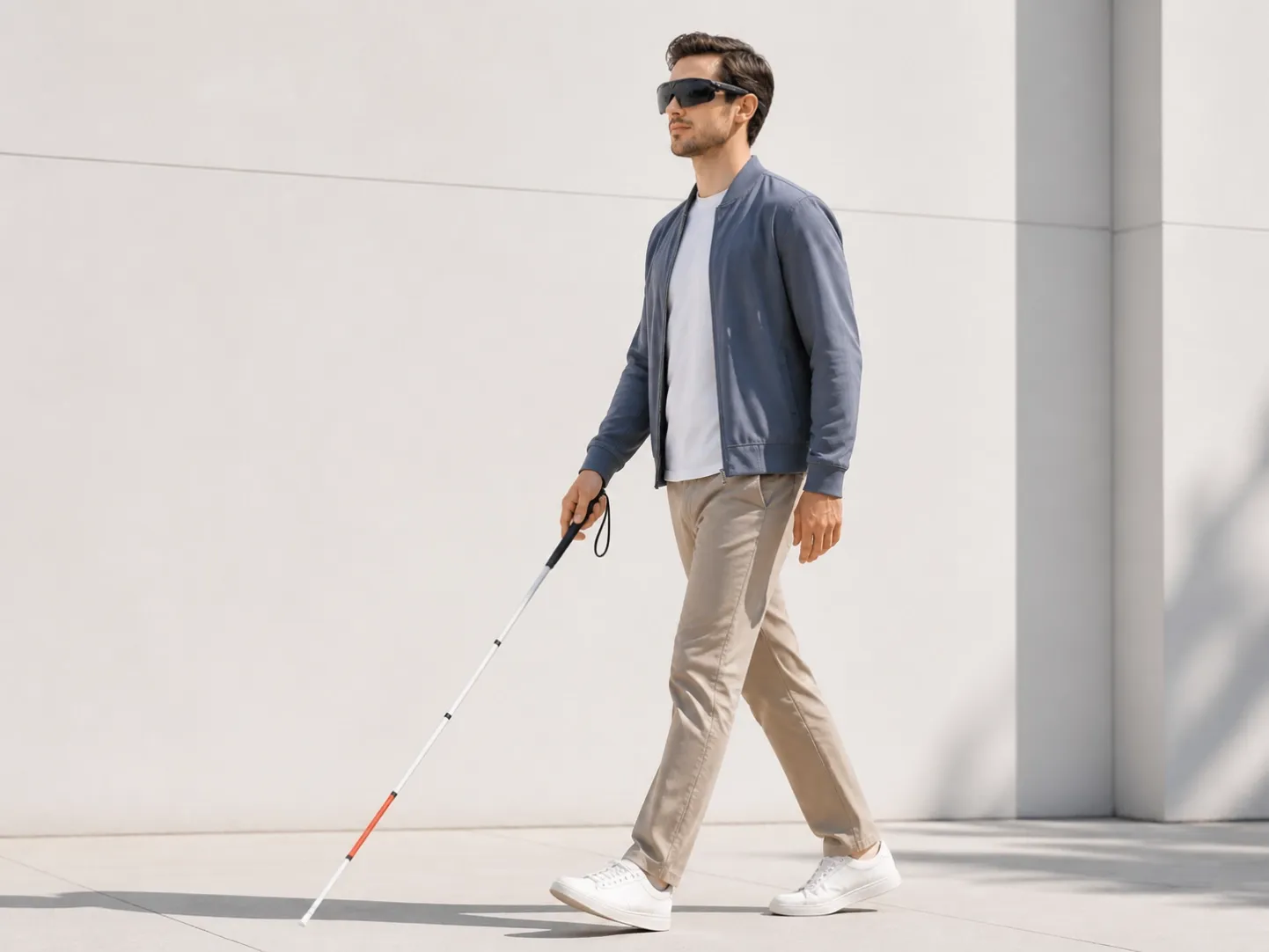
Recently, a B2B client approached us looking to source assistive smart glasses for the visually impaired, specifically requesting a pure Bluetooth - only data transmission setup with no WiFi required. This practical sourcing request prompted our engineering team to evaluate the physical limits of relying exclusively on Bluetooth for AI - powered wearable devices.
The appeal of a Bluetooth - only architecture is easy to understand. It offers lower power consumption, simplified hardware design, reduced component costs, and a more straightforward pairing experience with smartphones. For voice assistants, music playback, and hands - free calling, Bluetooth is a mature and highly efficient wireless solution.
However, once a wearable device incorporates a camera and cloud - based visual AI, the engineering requirements change significantly. Features such as scene description, text recognition (OCR), object identification, and AI - powered visual question answering require far more data than voice interactions alone. Understanding these technical boundaries is essential for OEM buyers and distributors evaluating smart glasses for assistive applications.
The Bandwidth Bottleneck: Why Visual AI Demands More Than Bluetooth
The key challenge in the Bluetooth vs. WiFi discussion is not software capability but wireless bandwidth. Unlike voice commands, camera - based AI must first capture images before they can be analyzed by cloud - based vision - language models (VLMs). In cloud - based AI systems, those images must then be transmitted to remote servers, processed, and returned to the user as spoken feedback.Most visual AI requests begin with image acquisition.
This workflow is especially relevant for assistive smart glasses designed for visually impaired users. A user may ask the glasses to read a restaurant menu, identify a product, recognize a traffic sign, or describe surrounding objects. , followed by AI processing and audio feedback.
Envision's official support documentation illustrates this requirement clearly. The company categorizes features such as Describe Scene, Ask Envision, and Call a Companion as internet - dependent because they rely on cloud - based image analysis or live video transmission (letsenvision, Which features of Envision Glasses need an internet connection?). Rather than functioning entirely on the glasses themselves, these services require continuous communication with remote AI services, highlighting the substantial data demands of camera - based assistive applications.
From an engineering perspective, this distinction is important. Bluetooth is highly efficient for transmitting control signals and audio streams, but cloud - based visual AI involves significantly larger data payloads. As image resolution and AI model complexity increase, wireless bandwidth becomes a primary system constraint rather than a secondary consideration.
Architecture | Suitable functions | Main limitation |
Bluetooth only,no internet | Calls,music,controls | No cloud AI |
Bluetooth to phone + mobile data | Voice AI,limited image requests | Phone dependency and latency |
Bluetooth + Wi-Fi | Frequent visual AI and large data | Higher power and complexity |
On - device AI | Selected offline functions | Hardware and model limitations |
Why Bluetooth Alone Becomes the Limiting Factor
Bluetooth technology was designed primarily for short - range, low - power communication between connected devices. According to the Bluetooth SIG, Bluetooth Low Energy (BLE) was designed for low - power wireless communication between connected devices, making it well suited for sensors, peripherals, and wearable accessories (Bluetooth, The next generation of Bluetooth® audio).
As a result, it is generally better suited for low - bandwidth communication than continuously transferring large volumes of camera - generated visual data.This makes it an excellent choice for microphones, speakers, wearable sensors, and user controls—but not for continuously transferring camera - generated visual data.
For assistive smart glasses, several communication tasks often occur simultaneously. The device may capture images, transmit voice commands, receive AI responses, maintain microphone input, and deliver spoken guidance through open - ear speakers. When these workloads compete for limited wireless resources, system responsiveness can quickly become the primary engineering challenge.
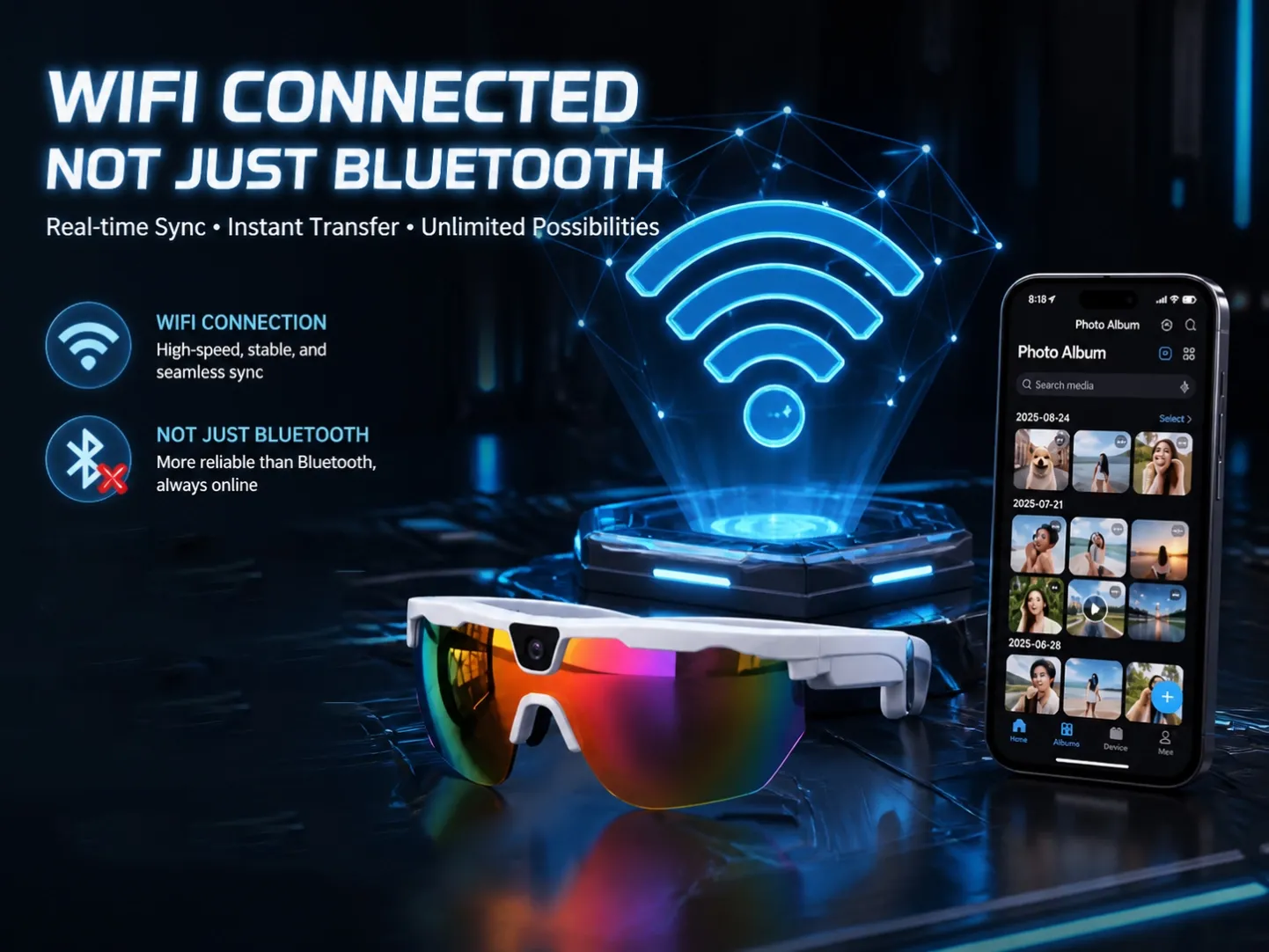
For this reason, this approach is reflected in commercial AI platforms such as Qualcomm's Snapdragon AR1. instead of relying on a single wireless protocol. Qualcomm's Snapdragon AR1 platform, for example, integrates both Bluetooth and WiFi, allowing Bluetooth to manage low - power audio and user interaction while WiFi provides the higher bandwidth required for camera - based AI workloads (Qualcomm, The Snapdragon AR1 Gen 1 is designed to power the next-generation smart glasses for seamless capture, livestreaming, notifications and powerful on-glass AI). This dual - wireless architecture helps balance power efficiency with the performance demands of multimodal AI applications.
Rather than representing unnecessary hardware complexity, the combination of Bluetooth and WiFi reflects a practical engineering solution to two fundamentally different communication tasks: low - power device connectivity and high - volume visual data transmission.
Why Low Latency Matters in Assistive AI
For distributors and OEM partners, wireless performance is not simply a specification on a product sheet, it directly affects user experience. This is particularly true for assistive AI applications, where users rely on timely feedback to understand their surroundings.
RayNeo explains in its technical guide, AI Glasses for Blind: How the Technology Works in Practice, that AI glasses designed for visually impaired users depend on timely obstacle recognition and responsive voice guidance to support independent mobility (Rayneo, AI Glasses for Blind: How the Technology Works in Practice). While the guide does not prescribe specific latency thresholds, it emphasizes that responsive perception is fundamental to delivering reliable navigation assistance.
This reinforces an important engineering principle: every stage of the communication pipeline - including image capture, wireless transmission, AI inference, and audio playback - contributes to the overall user experience. Reducing unnecessary communication delays is therefore a key design objective when developing assistive smart glasses.
The Sourcing Playbook: Matching Wireless Architecture to Product Requirements
Choosing the right wireless architecture ultimately depends on the intended application.
For voice - first wearable products focused on translation, music playback, voice assistants, or hands - free calling, a Bluetooth - only architecture remains an efficient and cost - effective solution. These applications primarily exchange compressed audio and control data, allowing Bluetooth to deliver excellent battery life and stable performance.
However, products equipped with cameras for OCR, object recognition, scene description, or other cloud - based visual AI functions require substantially greater communication capacity. In these scenarios, combining Bluetooth with WiFi provides a more practical system architecture. Bluetooth continues handling low - power audio and user interaction, while WiFi supports the higher - bandwidth transfer of visual information required by cloud AI services.
For OEM buyers evaluating assistive smart glasses, Bluetooth alone is generally insufficient for the complete communication pipeline required by cloud - based visual AI applications.For products intended to assist visually impaired users through camera - based AI services, current commercial AI wearable platforms indicate that a dual - wireless architecture offers the most reliable balance between responsiveness, usability, and long - term product performance.
Looking for AI smart glasses for wholesale, retail, or private - label projects? Penease Tech supports OEM/ODM customization, packaging, branding, and product selection for different market channels.Contact us for product details or sourcing support.