Aug 19, 2026News & Insights
AI Camera Glasses vs. AI Audio Glasses: Features, Use Cases, and Market Fit
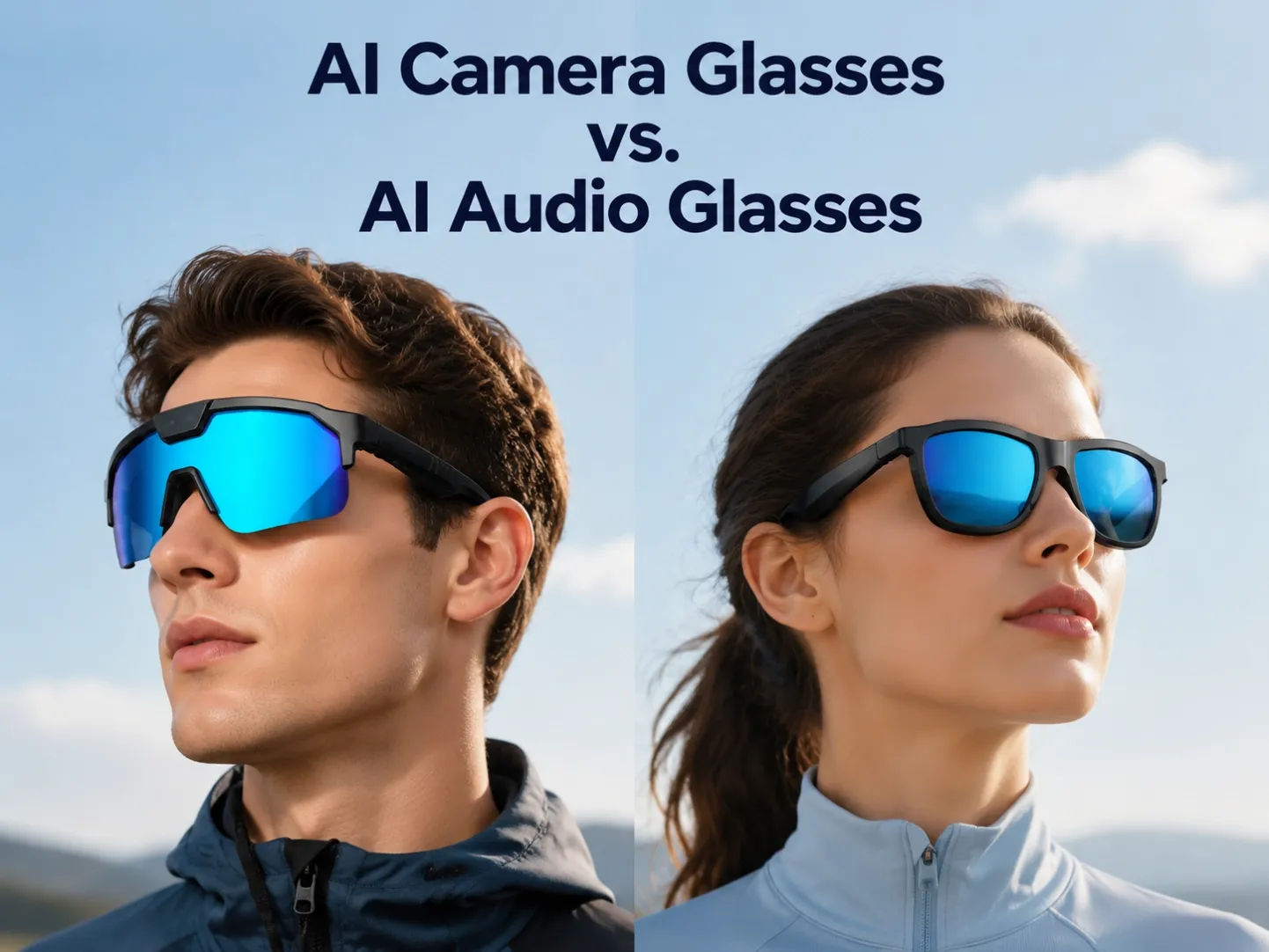
The expanding smart eyewear market includes several product categories with very different hardware architectures, user scenarios, and sourcing requirements. According to Counterpoint Research, intelligent eyewear shipments continued to grow strongly in Q1 2026, highlighting increasing demand across the category. Counterpoint Research – Intelligent Eyewear Up YoY Driven by Demand in Q1 2026 For B2B importers and distributors, the key question is not simply which type of smart glasses is better, but which architecture best matches the target market (Counterpoint, June 24, 2026). Camera-integrated and audio-only glasses differ significantly in processing requirements, power consumption, software capabilities, and potential use cases.
Hardware Architecture and Power Efficiency: Processing Load vs. Simplicity
The fundamental difference between camera-integrated and audio-only glasses is the amount of data the hardware needs to process. Camera glasses must capture, process, encode, and store visual information, creating additional demands on processing performance, memory, storage, and power management. Audio-only glasses generally have fewer computational requirements because their primary workloads involve audio playback, microphone input, wireless connectivity, and voice processing.
- Camera-Integrated Architecture: Camera glasses typically require additional processing resources for image capture, video encoding, storage, and AI-related workloads. Some product architectures distribute these workloads across multiple processors to reduce computational bottlenecks during demanding operations. For example, the CA-13S uses a JL7018F6 and Allwinner V821 architecture, together with an 8MP Sony IMX219 camera and local storage for captured media. Its overall weight is approximately 49.8g.
- Audio-Only Architecture: Without a camera and continuous image-processing workload, audio-only glasses can use a simpler hardware architecture. This can create more flexibility when optimizing weight, battery capacity, and overall component costs. For example, the AU-08 uses a lightweight 100mAh battery and weighs approximately 39.1g, while its primary functions focus on audio playback, voice interaction, and wireless connectivity.
The important sourcing consideration is therefore not simply the number of processors or battery capacity. Buyers should evaluate how the hardware architecture supports the intended workload and whether the resulting combination of weight, battery life, thermal performance, and functionality is appropriate for the target market.
Different Value Propositions: Visual AI vs. Audio Interaction
The two categories also address different user needs.
Audio-only smart glasses can be particularly suitable for everyday lifestyle, commuting, business, and gift-oriented channels. Without a camera, these products can focus on functions such as music playback, hands-free calling, voice assistants, and audio translation. Some models also combine audio functions with optical features. For example, electrochromic lenses can allow users to adjust lens tint according to changing lighting conditions, while microphone-based noise reduction can improve voice communication in environments with traffic or wind.
For B2B buyers, this category can be attractive when the target customer values lightweight design, simple interaction, and everyday wearable functionality without requiring camera-based AI.
Camera-integrated smart glasses, by contrast, introduce a visual input layer that significantly expands the potential functionality of the device. Depending on the hardware and companion software, camera glasses can support hands-free photography and video recording, image-based AI queries, text recognition, translation, and other visual-assistance functions.
These capabilities can be relevant to outdoor activities, field service, content creation, warehouse operations, and other scenarios where users benefit from capturing or interpreting visual information without holding a smartphone.
The distinction is particularly important for AI applications. A camera does not automatically make a pair of glasses an AI device. The final functionality depends on the complete system—including the camera, processing hardware, smartphone application, connectivity, and AI services behind the product.
Sourcing Playbook: Match the Product to the Market
For B2B procurement teams, product selection should begin with the intended customer scenario rather than the specification sheet.
- Outdoor, Sports, and Visual-AI Applications: Camera-integrated glasses may be more appropriate when customers need hands-free recording, image recognition, translation, or other camera-based functions. Buyers should pay particular attention to camera quality, image stabilization, processing performance, storage, battery life, and the software platform supporting visual AI.
- Lifestyle, Commuting, and Business Applications: Audio-only glasses can be a better fit when the primary requirements are music, calls, voice assistants, translation, or other audio-focused functions. Buyers can prioritize weight, battery efficiency, microphone performance, comfort, and optical features.
- Private-Label and Customization Projects: The development scope should also be considered. Camera-integrated products may involve additional hardware, software, image-processing, storage, and privacy considerations. Audio-only products can sometimes have a simpler development path when the project does not require camera-based functions. However, actual development time and customization costs depend on the supplier's existing platform and the requested modifications.
Ultimately, camera-integrated and audio-only smart glasses should not be treated as competing versions of the same product. They represent different hardware and application strategies. For distributors and sourcing managers, the better choice is the architecture that matches the customer's actual use case, target price, technical requirements, and expected market conditions.
Looking for AI smart glasses for wholesale, retail, or private-label projects? Penease Tech supports OEM/ODM customization, packaging, branding, and product selection for different market channels. Contact us for product details or sourcing support.